Table of Content

Roulette Online: Rules, Strategy, Live Dealer and Real Money Play

Last updated: July 2026

Disclaimer: This article is for informational and educational purposes only. Gambling involves real financial risk. No strategy eliminates the house edge or guarantees a profit. If you or someone you know is experiencing issues related to gambling, contact a licensed counselling service such as the National Council on Problem Gambling (1-800-522-4700) or BeGambleAware (0808-8020-133). Please gamble responsibly and within your means.

What Roulette Is and How the Game Works Online

Roulette is one of the oldest casino games still played worldwide. The premise is deceptively simple: a numbered wheel spins, a ball bounces across its pockets, and the pocket where the ball settles determines the winning number. Every bet on the roulette table is resolved by this single event. That simplicity is exactly what makes the game so enduring.

Whether you encounter it at a physical casino or through an online casino platform, the core mechanics stay the same. Understanding the components of the roulette game (the wheel, the table layout, and how outcomes are determined) gives you a solid foundation before placing any bets. Let's break those components down.

What Roulette Is and How the

The Roulette Wheel, Table and Spin Outcome

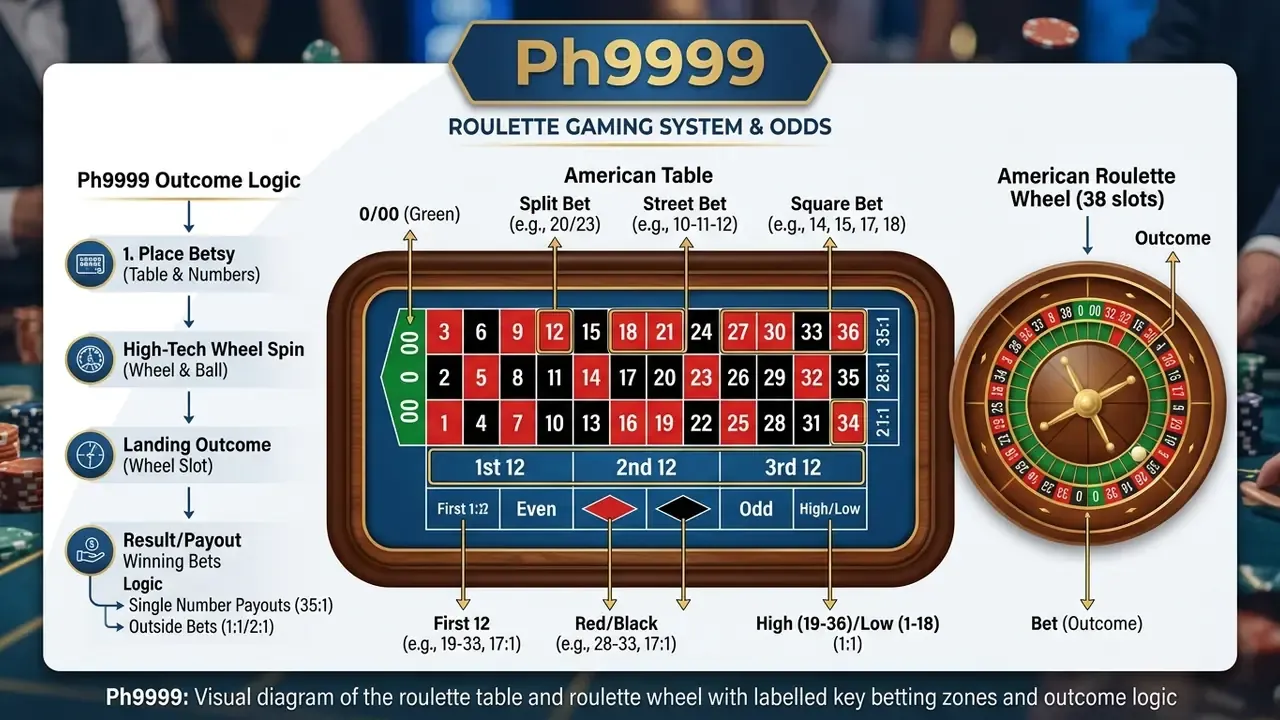
A standard European roulette wheel contains 37 numbered pockets: numbers 1 through 36, coloured alternately in red and black, plus a single green zero (0). An American roulette wheel adds a 38th pocket, a green double zero (00). The sequence of numbers around the rim differs between the two variants. The European wheel arranges numbers so that high and low, odd and even values alternate as evenly as possible. The American wheel uses its own distinct ordering.

The roulette table, sometimes called the felt, mirrors the wheel's number set in a grid layout. This grid splits into two broad zones. The inside area is where bets land on individual numbers or small groups of adjacent numbers. The outside area covers broader categories: red or black, odd or even, high (19-36) or low (1-18).

In an online roulette round, you select chip values and place them on the desired positions of the virtual felt using a click or tap interface. Once the betting window closes, the game engine determines the outcome.

In digital (RNG) roulette, a certified Random Number Generator produces a single integer mapped to the wheel's pockets. Independent auditing laboratories, most commonly Gaming Laboratories International (GLI) and eCOGRA, test these RNGs by running millions of simulated spins. They compare observed frequencies against theoretical expectations and verify that each pocket appears with equal probability within accepted statistical bounds.

For physical roulette wheels, both in land-based casinos and live-dealer studios, the outcome depends on real-world physics: rotor speed, ball velocity and launch angle, air resistance, and the geometry of the frets separating pockets. One study recorded 10,980 spins from a European roulette wheel in a Riga, Latvia casino and modelled the ball's deceleration using an Ornstein-Uhlenbeck stochastic process. The researchers found that the motion sequence (ballistic spin, descent, and scatter across deflectors) is largely consistent with a physical random process. Modern casinos inspect and recalibrate wheels regularly to prevent any single pocket from becoming statistically favoured.

The Roulette Wheel, Table and Spin

How Roulette Online Differs from Casino Roulette

Online roulette replicates the same bets, payouts, and probability structures as its land-based counterpart. The delivery mechanism, though, differs substantially. The game runs on a software platform accessed through a desktop browser or mobile application, enabling play from virtually any location with an internet connection.

Here are the key structural differences worth knowing:

Speed of play. Digital RNG roulette typically delivers approximately 60-80 spins per hour because there is no physical wheel to spin, no dealer to manage chips, and no announcements to make. Live-dealer online roulette operates at roughly 30-40 spins per hour, closer to land-based pace, because the dealer must physically spin the wheel and manage the table. Speed Roulette variants compress rounds to as little as 25 seconds spin-to-spin, around 50% faster than standard live tables.

Betting interface. Online platforms provide a point-and-click or tap-based chip placement system, often with features such as rebet, double, undo, and favourite-bet recall. Some live-dealer interfaces allow saving up to 15 favourite bet configurations for quick re-placement, a convenience unavailable at brick-and-mortar tables.

Simultaneous tables. Online platforms allow players to join multiple tables at once. This structural feature accelerates total wagers per unit of time and increases overall session exposure.

Event frequency and session metrics. A player-tracking study using machine-learning tree-based algorithms found that structural characteristics and session metrics together explained 26% of the variance in the number of games played in a session. Event frequency emerged as the single most influential characteristic, followed by maximum amount won on a single bet. This finding reinforces the importance of understanding how the speed and format of online roulette can shape gambling behaviour.

How Roulette Online Differs from Casino

Roulette Rules: How to Place Bets and Read Payouts

Before you play roulette for real money, or even in demo mode, it helps to understand how roulette rules actually work. The betting structure is more intuitive than it looks at first glance.

Inside and Outside Roulette Bets

In a standard roulette round, whether RNG-based or live-dealer, players place bets during an open betting window. Once the window closes (signalled by a timer in online play or the dealer's announcement of "no more bets" in live formats), the outcome is determined by the spin. All roulette bets are then settled automatically by the software, which credits winning accounts and deducts losses.

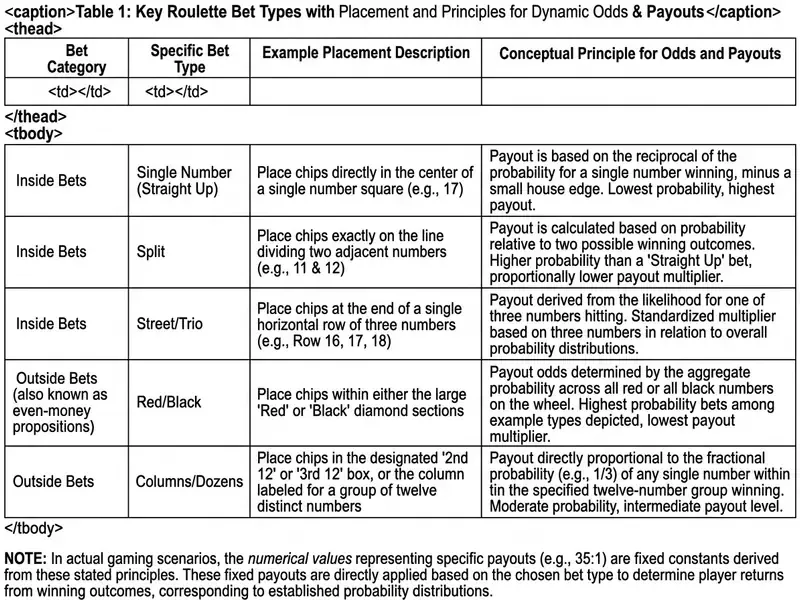
Inside bets are placed on the numbered grid and cover individual numbers or small clusters:

Bet TypeNumbers CoveredChip PlacementPayout
Straight Up1Directly on a single number35:1
Split2On the line between two adjacent numbers17:1
Street3At the end of a row of three numbers11:1
Corner4At the intersection of four numbers8:1
Six Line6At the intersection of two adjacent rows5:1

Outside bets are placed on the broader categories surrounding the grid:

Bet TypeNumbers CoveredPayout
Red / Black181:1
Odd / Even181:1
High (19-36) / Low (1-18)181:1
Dozens (1-12, 13-24, 25-36)122:1
Columns122:1

Online roulette interfaces typically permit multiple simultaneous bets per spin. You can combine inside and outside bets as you like, and the software resolves all wagers individually against the single winning number.

How Payouts and Odds Change by Bet Type

In European roulette, the probability of hitting a single number is 1/37 (approximately 2.70%), yet the payout is 35:1, as if there were only 36 possible outcomes. This gap creates the house edge: for every unit wagered on any bet, the casino expects to retain approximately 2.70% over the long run. The formula is straightforward. The payout is always calculated as if zero did not exist, but zero is always a possible result.

In American roulette, the additional double-zero pocket increases the divisor from 37 to 38 while the payouts remain the same. The resulting house edge rises to approximately 5.26%, nearly double the European figure. Over a long session, this difference is significant. For every $1,000 wagered, a European wheel statistically retains about $27, while an American wheel retains about $53.

The house edge applies uniformly to all standard roulette bets, inside or outside, in a given variant. Whether you bet $10 on red or $10 straight up on number 17, the expected loss per dollar wagered is the same (2.70% in European roulette). The difference is in variance: inside bets produce larger individual wins at much lower frequency, while outside bets produce smaller, more frequent returns. A simulation study running millions of rounds demonstrated that regardless of the roulette betting strategy applied, the long-run outcome converges toward the expected house edge. No combination of bets changes the casino's mathematical advantage.

How Payouts and Odds Change by

European Roulette vs American Roulette: Which Version Is Better

This is, honestly, one of the most common questions new players ask. And the answer is more clear-cut than you might expect.

Differences in Wheel, Numbers and Table Layout

The structural differences between European and American roulette are straightforward:

FeatureEuropean RouletteAmerican Roulette
Total Pockets37 (0-36)38 (0, 00, 1-36)
Green Pockets1 (single zero)2 (zero and double zero)
House Edge2.70%5.26%
RTP (Return to Player)97.30%94.74%
Number Sequence on WheelUnique European orderingDifferent American ordering
Special BetsFrench call bets (Voisins du Zero, Tiers du Cylindre, Orphelins) available in some versionsFive Bet (covering 0, 00, 1, 2, 3) unique to American

French roulette shares the European wheel's 37-pocket layout but adds rules that further reduce the house edge on even-money bets. Under the La Partage rule, if the ball lands on zero and you have placed an even-money bet (such as red/black or odd/even), you lose only half the wager. This effectively reduces the house edge on those bets from 2.70% to 1.35%. The En Prison rule offers an alternative: the even-money bet is "imprisoned" on the table for the next spin, and if it wins on that subsequent spin, the original stake is returned without additional winnings.

"In French Roulette, there's the La Partage rule: if you make an even-money bet and the ball lands on zero, you will lose only half your bet." - Evolution Gaming, Live Roulette game description.

These rules make French roulette mathematically the most favourable variant for players placing even-money bets. Choosing French roulette for even-money wagers, when available, is one of the few genuinely evidence-based tips for reducing expected losses. That is not a strategy claim. It is just math.

Which Roulette Game Suits Beginners and Strategy Play

For a new player, European roulette typically offers the clearest combination of simplicity and relatively lower house edge. The single-zero layout is easier to navigate than the American variant's additional pocket, and the 2.70% house edge provides a better mathematical baseline than the 5.26% of American roulette. Where French roulette with La Partage is available, it is the optimal choice for even-money bets, bringing the effective edge down to 1.35%.

Beginners benefit from starting with outside bets: red/black, odd/even, or high/low. The near-50% hit rate (18/37 in European roulette, or 48.65%) provides frequent feedback and helps develop familiarity with the roulette betting interface. Inside bets, while offering larger payouts, hit less often and can deplete a limited bankroll quickly.

For players interested in testing progressive betting systems (such as Martingale or D'Alembert), European roulette's even-money bets provide the standard testing ground. But it is essential to understand that no betting system alters the underlying house edge. The mathematical expectation remains 2.70% per unit wagered regardless of bet sizing strategy. We will get into why in the strategy section below.

Which Roulette Game Suits Beginners and

Roulette Demo and Free Play Before Real Money

What You Learn in Demo Mode

Demo or free-play modes in online roulette allow you to participate using virtual credits rather than real money. These simulators use the same RNG engine and payout tables as the real-money version. In well-regulated jurisdictions, operators are expected to ensure RTP parity between demo and real-money modes, though explicit legal mandates vary by jurisdiction.

Here is what roulette demo mode is genuinely useful for:

  1. Interface navigation. Learning hotkeys, chip selection, bet placement, undo, and rebet functions without financial pressure.
  2. Bet-type familiarity. Practising complex compound bets such as Voisins du Zero (a French call bet covering a specific set of numbers near zero on the European wheel), Tiers du Cylindre, and Orphelins. Understanding the chip pattern and cost of each.
  3. Bankroll pacing. Testing how quickly a bankroll depletes under different bet sizes and strategies. Observing the impact of variance over hundreds of simulated spins.
  4. Strategy dry-runs. Running progressive systems (Martingale, D'Alembert, Labouchere) in a risk-free environment to observe how rapidly stakes escalate and how often table limits are reached.

Canadian-focused guidance on RNG roulette emphasises that understanding the digital interface, bet types, and payout mechanics before committing real funds helps players make more informed decisions. That advice applies regardless of where you play roulette.

Important note: While the mathematical mechanics of demo and real-money roulette are identical, the psychological experience is not. Financial stakes and the potential for loss introduce emotional arousal, loss aversion, and risk-taking behaviour that simply do not arise when playing with virtual credits.

A study of 21,464 online customers found that people scoring 8 or above on the Problem Gambling Severity Index (PGSI) demonstrated markedly higher levels of gambling involvement across casino-style products, including roulette, relative to non-problem gamblers. A Japanese cross-sectional study (February 2023) reported that 12.2% of online casino participants met criteria for problem gambling (PG), with an adjusted odds ratio (aOR) of 2.41 (95% CI 1.86-3.13) for PG compared to non-participants.

What You Learn in Demo Mode

"Online casino gambling showed an incidence risk ratio of 2.33 (95% CI 1.78-3.04) for problem gambling scores of 8 or above." - Gambling Survey for Great Britain (2023) / Health Survey for England (2015-2018), comparative analysis.

Demo mode cannot replicate the emotional conditions of real-money play. It can teach interface skills and roulette rules, but it cannot prepare you for the psychological dynamics of risking actual funds.

When to Switch from Demo to Real Money Roulette

No universally accepted expert checklist defines a formal "readiness" threshold for transitioning from demo to roulette real money play. Responsible-gambling guidance from the UK Gambling Commission (2023) and the WHO's Gambling Disorder factsheet (2024) emphasises harm-detection indicators rather than approval criteria. A reasonable self-assessment before switching might include:

  • You can explain the house edge of the variant you intend to play.
  • You have practised your intended bet types and understand their payout structure.
  • You have set a loss limit and a time limit that you are prepared to enforce.
  • You recognise that no strategy guarantees a profit.
  • You have activated all available responsible gambling tools (deposit limits, session reminders, self-exclusion access).

Speed-of-play experiments show that slowing down an online roulette game reduces total expenditure. This suggests that players transitioning to real money should initially choose standard-speed live tables rather than Speed Roulette or Auto Roulette variants.

When to Switch from Demo to

Live Roulette and Live Dealer Roulette: What Makes Them Different

How a Live Dealer Roulette Game Works

Live dealer roulette is a live broadcast of a physical roulette game, streamed in high definition from a purpose-built studio or, in some Dual Play configurations, from the floor of a land-based casino. A human croupier operates the game, spinning a real wheel and launching a real ball. The results are determined by the actual bounce of a physical ball on a tangible wheel, not by an algorithm.

The round follows a consistent sequence:

  1. Dealer greeting and round opening. The croupier announces the new round and activates the betting window.
  2. Betting timer. A countdown timer appears on-screen, typically lasting 15-30 seconds, during which players place bets via the digital interface.
  3. Spin and ball drop. The croupier physically spins the wheel and releases the ball. Optical Character Recognition (OCR) cameras and sensors track the ball's movement and the wheel's rotation in real time.
  4. Result confirmation. When the ball settles, the winning number is automatically detected by the studio's camera system, displayed on-screen, and verified by the dealer.
  5. Automated settlement. The gaming software automatically credits winning bets and debits losing bets. No manual calculation is required by the dealer.

Event frequency in live roulette is inherently lower than in standard RNG roulette games because physical spins take time. A standard live roulette table produces approximately 30-40 spins per hour, compared to 60-80 spins per hour in RNG roulette. This slower pace gives players more time between decisions, and it also means that per-hour exposure to the house edge is lower.

How a Live Dealer Roulette Game

Live Roulette vs Standard Online Roulette

FeatureStandard RNG RouletteLive Dealer Roulette
Outcome DeterminationCertified Random Number GeneratorPhysical wheel spin filmed by HD cameras
Speed~60-80 spins/hour~30-40 spins/hour (25s in Speed Roulette)
Social InteractionNoneLive chat with dealer and other players
AtmosphereSoftware-rendered graphicsReal studio, real table, HD streaming
Availability24/7, instant play24/7 in most studios, may have seat limits
Bet LimitsOften lower minimumsTypically higher minimum and maximum bets
Fairness VerificationRNG audit certificatesPhysical wheel + regulatory studio audits
Favourite Bets FeatureVaries by platformUp to 15 saved bets in leading providers

Live dealer roulette games provide real-time interaction and atmosphere that replicates the feel of a physical casino. RNG roulette games prioritise convenience and speed. The roulette live casino format appeals to players seeking authenticity and social engagement, while RNG roulette suits players who prefer rapid-fire sessions and lower minimums.

Both live-dealer and RNG roulette can be fair. The key difference is in the mechanism of assurance. RNG roulette relies on software audits. Live-dealer roulette relies on physical equipment inspection plus studio regulation. Players benefit from live-dealer games through visible process (the spin, ball bounce, and landing are streamed in HD), reduced RNG anxiety, social experience through chat functionality, and structural pacing that naturally reduces per-hour exposure to the house edge.

Conversely, RNG roulette offers faster play, more variant diversity (including unusual configurations), and typically lower minimum bets, making it accessible for testing strategies in small-stakes environments.

Live dealer roulette games provide real-time

Modern live-dealer providers offer a wide range of roulette variants beyond the standard European and American tables. Some alter the base payout structure, which affects strategy considerations. Here are the ones you are most likely to encounter.

Lightning Roulette. This variant combines familiar European roulette mechanics with RNG-generated multipliers. In each round, between one and five numbers are randomly designated as "Lucky Numbers" and receive multipliers ranging from 50x to 500x on Straight Up bets. To fund these enhanced payouts, the base Straight Up payout is reduced from the standard 35:1 to 29:1 for non-Lucky Numbers. Why does this matter? Classic Martingale progression calculated for 35:1 payouts no longer works as modelled. Even-money bets (red/black, odd/even) remain unaffected by the Lightning mechanic. Lightning Roulette won Product Innovation of the Year at the Global Gaming Awards (G2E Las Vegas) and EGR's Game of the Year 2018.

XXXtreme Lightning Roulette. This amplifies the multiplier concept. Chain Lightning generates up to nine additional Chain Lightning Numbers with random multipliers, pushing the theoretical maximum payout to 2,000x on a Straight Up bet. The volatility is significantly higher than standard Lightning Roulette.

Immersive Roulette. Multiple camera angles provide cinematic coverage of the wheel. As the dealer spins, the broadcast shifts between wide shots, close-ups of the ball, and slow-motion replays. The rules and payouts are identical to standard European roulette. The differentiation is purely in the viewing experience.

Speed Roulette and Auto Roulette. Speed Roulette reduces the round duration to approximately 25 seconds spin-to-spin, roughly half the time of standard live roulette. Betting occurs only during the spin, requiring faster decision-making. Auto Roulette removes the human dealer entirely and uses an automated precision wheel, with Speed Auto Roulette delivering approximately 2,500 games per day.

French Roulette, Dual Play, Double Ball, and Instant Roulette. Live French Roulette features the La Partage rule, reducing the house edge on even-money bets to 1.35%. Dual Play Roulette streams from the floor of land-based casinos, allowing online players to join the same physical table as on-premise players. Double Ball Roulette launches two balls from a patented device in a single spin, producing two winning numbers and potential payouts up to 1,300:1. Instant Roulette uses twelve synchronised Auto Roulette wheels spinning almost continuously, providing near-instant results.


Popular Live Roulette Variants Worth Knowing

Lightning variants maintain a theoretical RTP comparable to European roulette but redistribute the payout structure through multipliers and reduced base Straight Up odds.

Roulette Strategy: What It Can and Cannot Do

This section describes betting strategies for educational purposes. No roulette strategy decreases the house edge or guarantees a win. The house advantage varies by variant but never equals zero. If at any time gambling feels out of control, seek help from a licensed professional.

"There's no roulette strategy that decreases the house edge or guarantees a win. Every casino you play with, whether live or online, will have an advantage over you." - PokerNews, "Best Roulette Strategy" guide (2023).

Let's be direct about this. The internet is full of articles promising "how to win at roulette every time." That is not possible. What strategy can do is help you manage your session, understand variance, and make more informed choices about bet types and game variants. What it cannot do is change the math.

Progressive and Non-Progressive Betting Approaches

The Martingale System. The most widely known roulette betting system. After every loss on an even-money bet, you double the stake. The first win recoups all prior losses plus a one-unit profit.

Example: Martingale progression starting at $2

SpinBetOutcomeCumulative Loss
1$2Lost-$2
2$4Lost-$6
3$8Lost-$14
4$16Lost-$30
5$32Lost-$62
6$64Lost-$126
7$128Lost-$254
8$256Lost-$510

After 8 consecutive losses, which on an even-money bet with 48.65% win probability occurs roughly once every 250-300 sequences, the player has lost $510 attempting to win a $2 profit. The system's fatal flaw is exponential bet growth: it requires an unlimited bankroll and unlimited table limits, neither of which exists in reality. Table maximum bet limits (typically $500-$10,000 in online roulette) cap the progression, guaranteeing that a sufficiently long losing streak produces unrecoverable losses.

The Labouchere System. Also known as the cancellation system. You begin with a player-chosen sequence of numbers (e.g., 1-2-3-4). Each bet equals the sum of the first and last numbers in the sequence. A win removes those two numbers; a loss appends the lost amount to the end. The process continues until the sequence is cleared or the bankroll is exhausted.

A simulation study running millions of Labouchere sequences confirmed that the system produces consistent short-term linear gains until a critical losing streak occurs, at which point the entire accumulated capital is lost.

After 8 consecutive losses, which on

"Simulations of millions of Labouchere sequences show consistent linear gains until a critical loss streak causes total capital loss; long-run outcome approaches zero." - Labouchere betting system simulation study (2023).

The D'Alembert System. A negative progression system. After a loss, increase the bet by one unit; after a win, decrease by one unit. More conservative than the Martingale since the bet growth is linear rather than exponential. But it still cannot overcome the house edge. In long sessions, the D'Alembert gradually bleeds the bankroll at the same expected rate: 2.70% per unit wagered in European roulette.

The Paroli (Reverse Martingale) System. After each win, double the bet; after a loss, reset to the base unit. After three consecutive wins, the bet resets. This system caps maximum exposure at the base bet during losing streaks and attempts to capitalise on winning streaks. It does not change the mathematical expectation.

Example: Paroli progression starting at $1

The D'Alembert System. A negative progression
SpinBetOutcomeRunning Profit
1$1Win+$1
2$2Win+$3
3$4Win+$7
4$1Loss+$6
5$1Loss+$5
6$1Win+$6

The James Bond Strategy. Distributes a fixed total stake across three bets in a single spin. Using a $200 example: $140 on 19-36 (covers 18 numbers), $50 on 13-18 (covers 6 numbers), $10 on zero. This configuration covers 25 of 37 numbers in European roulette. The player loses only if the ball lands on 1-12. The failure probability is 12/37, roughly 32.4% per spin, and each failure costs the full $200 stake. The house edge is unchanged at 2.70% over the long run.

Flat Betting. The simplest non-progressive approach. You wager the same amount every spin. No escalation, no chasing losses. The expected loss rate is the same 2.70% per unit, but the variance is steadier and the bankroll demand is lower.

The James Bond Strategy. Distributes a
AspectProgressive (e.g., Martingale, Labouchere)Non-Progressive (e.g., Flat Betting)
Bet SizeChanges based on prior outcomesRemains constant
Short-Term ProfileFrequent small wins, rare large lossesSteady variance, predictable loss rate
Bankroll RequirementHigh (exponential or linear growth)Lower (fixed amount per spin)
Table Limit RiskHigh (can hit maximum bet quickly)Low (bet stays within limits)
Long-Run House EdgeUnchanged (2.70% European)Unchanged (2.70% European)

Common Mistakes When Choosing a Roulette Strategy

The biggest mistake? Confusing short-run variance with strategy effectiveness. A player who wins seven Martingale sequences in a row might genuinely believe the system "works." The Martingale Index, a formal metric designed to measure the degree to which a strategy's apparent success is attributable to increasing bet sizes after losses, reveals the problem.

"The Martingale Index quantifies how much apparent strategy success stems from betting more when losing, concealing tail risk of rare but catastrophic loss events." - Martingale Index paper (2023).

Strategies that increase position size after losses and reduce it after gains may show smooth upward equity curves for a while. But the index reveals that this smoothness comes at the cost of hidden exposure to rare but devastating loss events.

Other common mistakes include overestimating win potential, ignoring the odds of the specific variant being played, and choosing a strategy without considering game type and betting limits. For instance, applying Martingale logic to Lightning Roulette's reduced 29:1 Straight Up payout is a structural mismatch that many players overlook.

A note on biased wheels: historically, some players attempted to identify and exploit physical biases in roulette wheels. Modern casino wheels are manufactured to tight tolerances, regularly inspected with electronic levelling and frequency-tracking tools, and replaced or recalibrated when statistical monitoring detects anomalies. In the context of online play, this approach is entirely irrelevant. RNG roulette has no physical wheel, and live-dealer studios use the latest hardware under constant surveillance.

Strategies that increase position size after

Roulette Quick-Reference Card

VariantHouse EdgeBest For
French (La Partage)1.35% (even-money bets)Even-money strategy play
European2.70%General play, beginners
American5.26%Avoid unless seeking Five Bet option
StrategyTypeRisk LevelBankroll Demand
Flat BettingNon-progressiveLowLow
D'AlembertProgressive (linear)MediumMedium
ParoliProgressive (positive)MediumLow-Medium
MartingaleProgressive (exponential)HighVery High
LabouchereProgressive (cancellation)HighHigh
James BondFixed multi-betMediumMedium per spin

How to Choose the Best Roulette Casino or Live Casino Offer

What to Check Before You Play Roulette for Real Money

Selecting an online roulette casino or live casino offer requires careful attention to fairness, regulatory compliance, and technical audits. For RNG-based roulette, the gold standard is independent certification by laboratories such as GLI, eCOGRA, BMM Testlabs, or iTech Labs. These auditors test the RNG algorithm, verify payout percentages, and confirm that the software has not been tampered with. Certification reports are typically available on the casino's website or through the licensing authority's public register.

Before placing a first real-money roulette bet, consider these steps:

  1. Verify the casino's licence and audit status. Check the regulatory body's public register. Look for current RNG or live-dealer audit certificates.
  2. Understand the variant's house edge. Choose European or French roulette over American roulette when possible.
  3. Set a loss limit before starting. Determine a fixed amount you are prepared to lose and stop when it is reached. Activate the platform's deposit-limit tool.
  4. Set a session time limit. Use the platform's session-reminder feature. Speed-of-play research suggests that shorter sessions with natural breaks reduce total expenditure.
  5. Start at low stakes. Use the minimum bet size until you are comfortable with the interface and tempo.
  6. Avoid chasing losses. No strategy changes the house edge. Doubling down after losses accelerates bankroll depletion.
  7. Use responsible gambling tools proactively. Deposit limits, loss limits, session reminders, cooling-off periods, and self-exclusion are available on all regulated platforms.
What to Check Before You Play

Which Roulette Format Gives the Clearest Player Benefit

This depends on what you are looking for. Here is a practical breakdown:

Demo mode is best for learning. It lets you practise roulette rules, test bet types, and explore the interface without financial risk. The limitation is that it cannot replicate the emotional weight of real-money play.

Live dealer roulette is best for the casino experience. The visible spin process, human interaction, and slower pace create a more immersive session. The structural pacing also naturally reduces per-hour exposure to the house edge. For players who value transparency and atmosphere, the roulette live dealer format is a strong choice.

Standard online roulette is best for speed and simplicity. Lower minimums, faster rounds, and more variant diversity make it accessible for testing strategies in small-stakes environments. The trade-off is higher event frequency, which means more cumulative exposure to the house edge per hour.

A Canadian nationwide study of 10,199 adult gamblers found that breadth of gambling involvement, engaging in multiple product types, was a stronger predictor of problem gambling than any single game type. Casino products including roulette were consistently identified among the higher-risk product categories. This does not mean playing roulette causes problem gambling. The relationship is correlational. But the evidence is clear that online casino products are among the higher-risk gambling formats, and choosing your format thoughtfully is part of playing responsibly.

Which Roulette Format Gives the Clearest

Responsible Gambling Tools: What Actually Works

Warning messages are among the most commonly deployed responsible gambling interventions. However, a randomised controlled trial with 2,305 UK-based online gamblers tested two forms of the industry's "Take Time to Think" messaging against a no-message control.

"In an RCT of 2,305 UK online gamblers, 'Take Time to Think' showed no credible effect on funds bet, play speed, or spin count." - Randomised controlled trial, UK online roulette players (2023).

Neither the persistent on-screen slogan nor the prominent popup prior to play reduced the proportion of funds bet, increased engagement with help-service links, slowed play speed, or decreased the number of spins played. This does not mean responsible messaging is valueless. It may contribute to broader public awareness. But it should not be relied upon as a standalone harm-reduction tool.

What does work? Structural interventions targeting game speed and bet limits show more promising results.

"Enforcing a 60-second minimum spin interval reduced gambling expenditure across all wealth levels, primarily through fewer spins rather than smaller individual bets." - Randomised online experiment, 1,002 UK residents, online roulette (2023).

The mechanism is primarily one of reduced opportunities: fewer spins per hour means fewer chances to lose, which mechanically lowers total expected losses for a given session duration. For roulette specifically, this means that the choice of game variant has real consequences. Auto Roulette and Speed Roulette, with their compressed round times, structurally expose players to more betting opportunities per hour, and therefore more cumulative exposure to the house edge, than standard live-dealer tables.

Roulette is also a common game featured in gambling livestreams on platforms such as Twitch and YouTube. Streamers often present a romanticised image of casino play, emphasising large wins while spending less time on losses. For viewers, especially younger audiences, this creates a potentially misleading impression of the game's risk profile. Worth keeping in mind.

The mechanism is primarily one of

FAQ About Roulette Online, Live Dealer and Real Money Play

Is Live Roulette Actually Live?

Yes, in regulated casinos. Live dealer roulette is genuinely streamed in real time from purpose-built studios or land-based casino floors. The ball's trajectory on a physical wheel is governed by real-world physics: rotor speed, ball velocity, fret geometry, and air resistance. The multi-camera HD streaming setup shows the spin, bounce, and landing in real time, including slow-motion replays in some variants. Licensed operators comply with all regulatory requirements in their operating jurisdictions.

Are Live Roulette Tables Fixed?

In licensed and regulated casinos, live roulette tables are not fixed. Regulatory bodies such as the UK Gambling Commission, the Malta Gaming Authority, and the New Jersey Division of Gaming Enforcement require independent testing and ongoing monitoring of both the physical equipment and the studio's digital infrastructure. Unlike an RNG, which could theoretically be compromised through software manipulation, a physical wheel produces outcomes through a mechanical process visible on camera. The odds and rules of all live roulette games are posted for players to review, supporting transparency and informed play. Always verify that the casino holds a current licence from a recognised regulator.

What Is the Best Type of Roulette to Play?

French roulette with the La Partage rule offers the lowest house edge (1.35% on even-money bets). If French roulette is unavailable, European roulette (2.70% house edge) is the next best choice. American roulette's 5.26% edge makes it the least favourable variant for players.

Can a Strategy Guarantee I Win at Roulette?

No. Every roulette strategy operates within the constraints of the house edge. No system, whether Martingale, Labouchere, D'Alembert, or any other, changes the mathematical expectation. Strategies manage variance and bet sizing, not probability.

What Is the Difference Between RNG Roulette and Live Dealer Roulette?

RNG roulette uses a certified software algorithm to determine outcomes and runs at 60-80 spins per hour. Live dealer roulette uses a physical wheel and human croupier, streamed live, at approximately 30-40 spins per hour. Both can be fair when properly regulated and audited.

How Do Lightning Roulette Multipliers Affect Strategy?

Lightning Roulette reduces the base Straight Up payout from 35:1 to 29:1 and adds random multipliers (50x-500x) to 1-5 numbers per round. This changes the risk/reward profile for Straight Up bets and makes Martingale calculations based on 35:1 payouts inapplicable. Even-money bets are unaffected by the Lightning mechanic.

What Is Sports Betting vs Casino Roulette?

Sports betting involves wagering on the outcomes of real sporting events, where analysis, form, and data can inform decisions. Roulette is a pure game of chance: every spin is independent, and no amount of analysis changes the probability. They are fundamentally different product categories. A sports-first media platform differs from a casino portal because sports betting content centres on analytical skill, while casino content centres on understanding odds and managing risk.

Is Online Roulette Legal?

Legality depends entirely on your jurisdiction. In regulated markets (UK, many US states, parts of Canada, EU countries), licensed online casinos are legal. In some jurisdictions, including countries where gambling laws predate the internet, such as those still operating under legacy frameworks like the Public Gambling Act of 1867, online casino play may exist in a legal grey area. Always check local laws before playing, and be aware that payment restrictions from local banks or mobile wallets may apply in certain regions.

How Do Deposits and Withdrawals Work for Online Roulette?

Methods vary by casino and jurisdiction. Common options include credit/debit cards, e-wallets (PayPal, Skrill, Neteller), bank transfers, and in some markets, mobile payment services. In jurisdictions with banking restrictions on gambling transactions, players may encounter blocked deposits or delayed withdrawals. Always verify the casino's payment options and processing times before depositing.

Conclusion

Online roulette in 2026 offers an unprecedented range of formats, from rapid-fire RNG games to cinematic live-dealer experiences with multipliers reaching 2,000x. The underlying mathematics, however, remain unchanged. The house edge is always positive, no strategy eliminates it, and informed play means understanding this fundamental reality rather than trying to overcome it.

The most impactful decisions you can make are not about strategy. They are about structure: choosing French or European roulette over American, selecting standard-speed tables over Speed or Auto variants, setting hard loss and time limits before play begins, and using every responsible gambling tool the platform provides.

The research evidence is clear on several points. Warning messages alone do not reduce gambling expenditure. Speed-of-play limits do. Event frequency is the single strongest structural driver of session intensity. And no progressive betting system changes the expected outcome. The Martingale Index confirms that apparent short-term success from such systems conceals hidden tail risk.

Play informed. Play within your limits. And recognise that the best roulette "strategy" is choosing the game structure that minimises the house's advantage and the pace at which it compounds.

For a broader look at the iGaming landscape, see our iGaming overview.

Conclusion. Online roulette in 2026 offers